Online Education: The Great Revolution in Classrooms
Hey everyone! Have you ever stopped to think about how school has changed? That whole thing with chalkboards and chalk, notebooks full of notes, seems like something from the last century.
The truth is that 21st-century education is going through a massive revolution. It’s not just about putting a computer in the room, you know?
It’s about flipping the switch in our heads and understanding that the way we learn and teach has changed for good. Technology in education isn’t an accessory; it’s the very engine of change. It’s our way of preparing the kids for a future that, honestly, we can’t even fully imagine.
This is a serious topic, but let’s face it head-on, in a good way. It’s a kitchen conversation, with coffee and cheese bread.
The New Way of Teaching: The Teacher Becomes a Maestro
That teacher who talked non-stop at the front of the class, as if they were a robot spewing out information, is a thing of the past. Today, the teacher is more of a maestro, conducting an orchestra of learning.
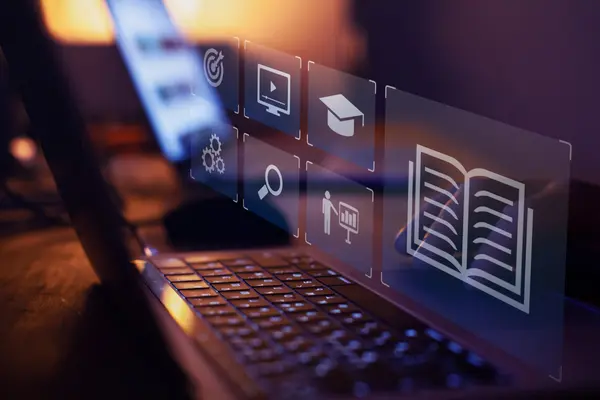
Digital tools like learning platforms, school management software, and multimedia resources have become their new toolbox. It’s like having an arsenal of superpowers to create classes that actually stick in our minds. And the best part?
The teacher gets extra time, which they used to spend correcting tests. They can use that time for what really matters: looking into the student’s eyes, understanding their difficulties, and giving personalized support.
Can you imagine the difference that makes? Knowing in real-time where your student is having problems, which subject they haven’t grasped yet. It’s no longer a guess. It’s based on data. It’s much more effective.
Gadgets and Tools That Are Changing Everything
- Interactive Whiteboards: They’ve replaced traditional blackboards. We can watch videos, browse the internet, and even draw on the screen, all in real-time. It’s much cooler than just looking at white letters.
- Learning Management Systems (LMS): Think of Moodle or Google Classroom. They are like the online headquarters of the school. Everything is there: class materials, assignments, tests, and even a channel to talk to the teacher.
- Virtual Reality (VR) and Augmented Reality (AR): Have you ever thought about taking a trip to Egypt without leaving the classroom? Or entering the human body to see how the heart beats? VR and AR do that and turn learning into an otherworldly experience.
Tailored Learning: No More “One Size Fits All”
Old-school education treated everyone the same. The quick student had to wait, and whoever took a little longer fell behind. That’s changed. Technology in education allows everyone to go at their own pace. It’s like a custom-made shoe for your foot.
Artificial intelligence algorithms analyze how you learn. They notice if you have an aptitude for math, or if you need more Portuguese exercises.
Then, they suggest content and activities that are just right for you, challenging you at the perfect level. This not only improves the student’s journey, but also prevents the frustration of not being able to keep up with the class. It’s a system that adapts to you, not the other way around.
The Role of Personal Data in Modern Teaching
We know that personal data is important, but in education, it’s crucial. The collection and analysis of student performance, from online tests or the time they spend on certain activities, gives us a map of learning.
With this information, we can:
- Spot patterns: Discover which parts of the subject the whole class is struggling with.
- Help before the problem: Anticipate when a student will need extra help, even before they do poorly on a test.
- Know what works: Understand if a new teaching method is, in fact, improving learning.
Today’s Students: Connected and Protagonists
Today’s kids were born with a cell phone in their hands. They are the digital generation. Instead of telling them to put their devices away, the smarter schools are teaching them to use them as a powerful tool.
The smartphone that was once a distraction has become a portal of knowledge, a creation lab, a collaboration tool. 21st-century education has to be like this, connected, otherwise it doesn’t make sense to them.
Technology makes the student go from passive to being the protagonist of their own learning. With the internet, they can search, question, and even teach themselves about anything that interests them.
The classroom is transformed into a place of collaboration, where students work together on learning projects, share ideas, and find solutions to real problems.
Skills for a Professional Future
Modern education isn’t just concerned with transmitting knowledge. It wants us to leave school with the right skills for the job market of the future, which, let’s be honest, is changing in the blink of an eye. Technology in education helps us develop:
- Critical Thinking: With so much information out there, we need to know what’s true and what isn’t. Technology teaches us to filter and use data to solve real problems.
- Creativity: Design software, video editing, and even programming open up an infinite range of possibilities for us to express our ideas.
- Collaboration: We learn to work in a team on online projects, to communicate clearly, and to solve problems together. This is a basic skill in today’s world.
The Flip Side: Challenges and the Future
Of course, it’s not all roses. We need to talk about digital inequality. Not everyone has quality internet or a computer at home, and the school has to think about that.
There’s also the issue of teacher training. Many of them need help and training to feel comfortable with these new tools. And, of course, there’s online safety. It is essential that we learn to navigate the internet in a safe and responsible way.
But the opportunities are endless, folks. 21st-century education: how technology is transforming classrooms points us to a future where learning is fairer and more accessible for everyone, no matter where you live.
The technology in our hands has the power to break down barriers, connect people from different cultures, and make education a truly global experience. It’s a promising future, but it requires work from everyone.
It’s a gigantic change, but we are in the middle of it. And we have to make the most of it.